
By Masoodi Mehreen
In the picturesque yet challenging landscapes of Hanjipora Kupwara, Kashmir, 31-year-old Shayista stands as a quiet force of determination. Her life, like many others in this remote region, has been shaped by hardship but not defined by it. With limited opportunities and mounting financial pressures, Shayista held on to a dream that seemed distant: to start her own Aata Chakki (flour mill).
Married to a daily wage laborer and mother to three young children, Shayista’s daily life is a delicate balance between hope and survival. Forced to drop out of school after the 9th grade due to financial constraints, she knows firsthand the cost of limited opportunities. But where formal education paused, her resilience and entrepreneurial spirit began to rise.
Kupwara’s traditional water-powered flour mills once served the local community well. However, the increasing impact of climate change marked by reduced river flows and water scarcity made this age-old method unreliable. The resulting gap in affordable, local flour supply hit families hard, especially in remote areas.
Shayista saw a solution. She envisioned setting up an electric flour mill—independent of natural water sources and capable of serving her community throughout the year. But vision alone wasn’t enough; she lacked the financial resources, guidance, and technical know-how to get started.
That’s when she became part of JAZBA, an initiative by the TYCIA Foundation supported by SIDBI in collaboration with district Administration and Indian Army dedicated to supporting grassroots changemakers. Through JAZBA, Shayista received critical support access to an electric flour mill, mentorship, and training that helped transform her idea into reality.
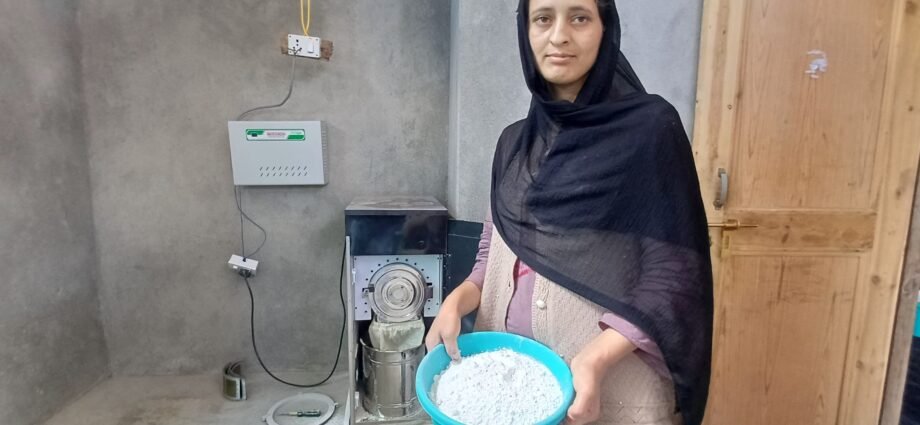
With the support she received, Shayista launched her small-scale electric Aata Chakki from her home. What began as a humble effort soon became a source of consistent income and renewed dignity. Today, she earns almost 2.5 to 3 lakh annually. she not only grinds flour for local families but also inspires others in her village to believe in the power of self-reliance.
Her Aata Chakki does more than produce flour—it symbolizes determination, adaptability, and the courage to dream. Every rotation of the grinding stone is a step toward a better life for her children and a reminder that change begins with one person’s will.
While Shayista’s journey with JAZBA has just begun, she stands today as a symbol of what is possible when opportunity meets resilience. Her story is not just one of survival it is one of rising, building, and becoming an inspiration for many women like her who are still waiting for their chance.