
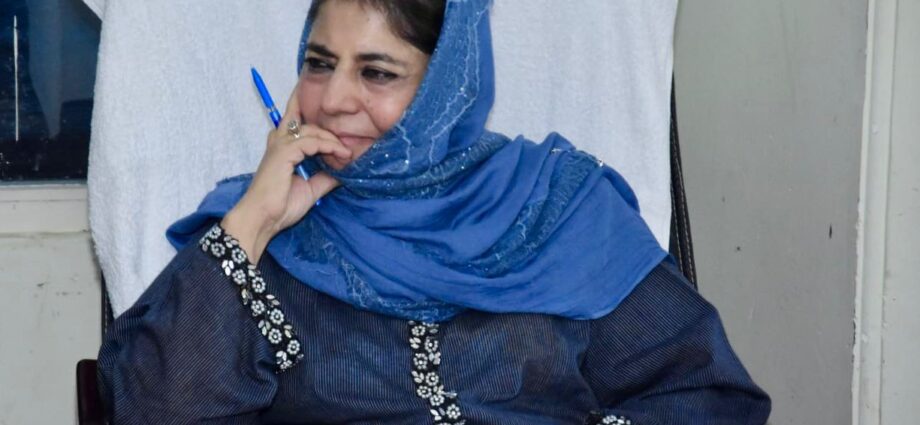
Katra, February 28(KNB): Continuing her public outreach programme, Mehbooba Mufti on Friday held a “Gal Baat” interaction in Katra, the base camp of the Mata Vaishno Devi Yatra, where residents raised serious concerns over increasing commercialisation of the pilgrimage and growing civic distress in the town.
Members of the Sangarsh Samiti welcomed Ms. Mufti and appreciated her outreach, describing it as a rare effort to directly listen to local grievances. The Samiti strongly flagged opposition to the proposed ropeway project under the Shri Mata Vaishno Devi Shrine Board, warning that it would divert pilgrims away from the traditional Yatra route and severely impact its sanctity, history and the livelihoods attached to it for generations.
“The traditional Yatra track sustains pony operators, pithuwalas, palki bearers, shopkeepers, transporters, hoteliers and daily wagers who have served as the true custodians of the Yatra. Any diversion of pilgrim flow without rehabilitation and consultation will devastate this entire economic chain,” a Sangarsh Samiti representative said.
The Samiti stressed that the impact would extend well beyond Katra. “Families from surrounding villages, nearby districts and even Jammu depend on seasonal and year-round employment linked to the traditional route. This is not merely about one project—it is about safeguarding a historic and sacrosanct route and a wider regional livelihood network,” members said.
The interaction took an emotional turn when a young student broke down while speaking about what he described as ecological damage being inflicted on the sacred Trikuta Hills. Referring to recent landslides, deforestation and hill cutting, he warned that the fragile mountains—revered by lakhs of devotees—are being pushed beyond their ecological limits. His remarks drew strong reactions, with several participants echoing concerns over environmental degradation.
Responding to the issues raised, Ms. Mufti said the Yatra is both a matter of faith and the backbone of Katra’s local economy. “The people who have been custodians of this pilgrimage town for decades cannot be sidelined in decisions that affect their survival, environment or faith,” she said.
Calling for transparency and meaningful stakeholder consultation, she added, “Development must be inclusive and environmentally responsible. Projects that alter the economic and ecological balance of the town must first address the concerns of those whose livelihoods and heritage are directly at stake.”
Beyond the ropeway issue, residents highlighted acute water scarcity during peak pilgrimage seasons, inconsistent supply in residential wards and heavy dependence on private tankers, pointing out that infrastructure has failed to keep pace with rising pilgrim footfall.
Electricity shortages and unscheduled power cuts were also raised, with traders stating that erratic power supply disrupts business operations and daily economic activity. Participants noted that despite generating substantial revenue through the Yatra, Katra continues to struggle with unreliable basic utilities.
Healthcare gaps featured prominently, particularly staff shortages at the Sub-District Hospital and limited availability of specialists during peak seasons. Concerns were also expressed over higher secondary education, including the shortage of subject-specific lecturers and the lack of skill development opportunities for local youth.
The interaction concluded with a collective demand for structured dialogue on Shrine Board decisions, protection of the traditional Yatra route, safeguarding of livelihoods, environmental conservation of the Trikuta Hills, and a comprehensive development plan prioritising water supply, reliable electricity, sanitation, strengthened healthcare and improved educational infrastructure for the people of Katra.(KNB)