
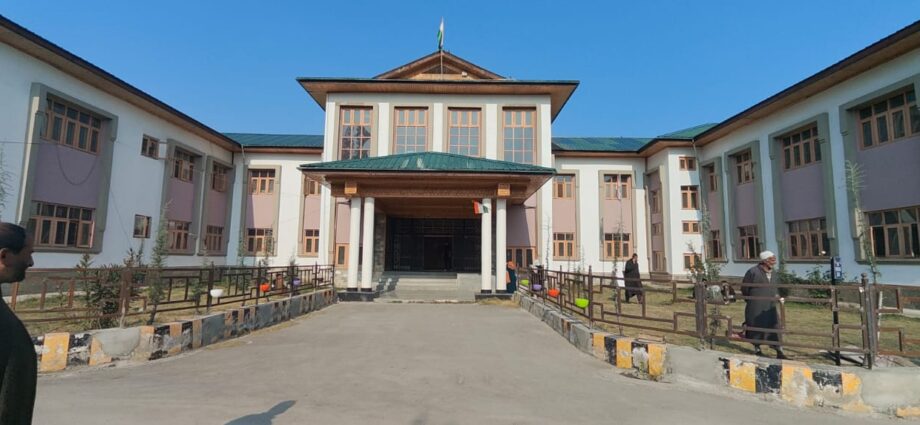
Court of Special Judge Anti-Corruption Pulwama, presided over by Dr Noor Mohammad Mir, delivers verdict in decades-old fraud case, exposing systemic manipulation of recruitment records
Srinagar, Mar 31(KNB): In a significant judgment delivered on March 31, 2026, the Court of Special Judge Anti-Corruption Pulwama, presided over by Dr Noor Mohammad Mir, convicted six persons in a decades-old case involving the fraudulent appointment of a teacher in the Education Department, describing it as a systematic subversion of the recruitment process and public trust.
The court held Assad-Ullah Lone, Ghulam Mohammad Sheikh, Bashir Ahmad Shah, Syed Showkeen Andrabi, Mohammad Ashraf Khan and Hamida Akhter guilty under provisions of the J&K Prevention of Corruption Act and the Ranbir Penal Code. The court observed that the accused acted in active conspiracy to manipulate official records, forge documents and illegally secure a government job, thereby causing wrongful loss to the state exchequer.
The case dates back to September 1998 when it was registered on the basis of reliable information that Hamida Akhter, a resident of Bijbehara, had been working fraudulently as a teacher at Government High School Goripora in Pulwama. The investigation revealed that she had neither applied for the post nor appeared in any selection process. Despite this, she was projected as having been selected through the Services Selection Board in 1990 and shown to have joined service through fabricated records.
During the course of investigation, it emerged that the accused persons had created an entirely false service history in her favour. Fake appointment orders, transfer orders, relieving orders and LPCs were prepared, while forged entries were made in the service book to give an impression of continuous employment. Official verification confirmed that no such orders had ever been issued by the Directorate of School Education or the concerned Zonal Education Office, exposing the fabricated nature of the documents.
The court placed significant reliance on forensic evidence, which authenticated the signatures appearing on official documents, including acquaintance rolls and service records. It was established that Assad-Ullah Lone, who was then serving as Headmaster, and Ghulam Mohammad Sheikh, a Junior Assistant, allowed Hamida Akhter to continue in service without verifying the genuineness of her appointment. They processed and drew salary in her favour, resulting in illegal withdrawal of Rs 29,952 from the government treasury, thereby causing loss to the state and corresponding gain to the beneficiary.
The investigation further revealed that a sum of Rs 60,000 had been paid as illegal gratification to facilitate the fraudulent appointment. The court observed that the accused persons, particularly those within the department, used their knowledge of official procedures to execute the conspiracy and manipulate the system from within.
The trial in the case spanned more than two decades. Charges were framed in 2001, and the prosecution examined eighteen witnesses to establish its case. The evidence proceedings concluded in 2009, after which the accused were examined. Despite the prolonged duration of the trial, the court held that the evidence on record clearly established the guilt of the accused beyond reasonable doubt.
Upon conviction, the court sentenced the accused to five years of imprisonment along with a fine of Rs 50,000 under corruption and conspiracy charges. They were further sentenced to five years of imprisonment and a fine of Rs 30,000 for offences related to forgery, and three years of imprisonment with a fine of Rs 20,000 under cheating provisions. All sentences shall run concurrently, making the effective term of imprisonment five years. The court also provided for additional imprisonment in case of default in payment of fines.
In its observations, the court stated that corruption is not a victimless crime but a “cancer” that erodes public trust and damages institutions. It noted that fraudulent appointments in the education sector not only deprive deserving candidates of opportunities but also adversely affect the future of students. The court emphasised that the accused had not merely forged individual documents but had fabricated an entire service record spanning several years.
Rejecting the plea for leniency based on the delay in trial and the advanced age of the accused, the court held that such factors cannot override the seriousness of offences involving moral turpitude. It further observed that granting undue leniency in such cases would send a wrong message to society and undermine the rule of law.
Stressing the need for deterrence, the court held that the integrity of the recruitment process is fundamental to governance and that any compromise in this regard must be dealt with firmly. It concluded that punishment in such cases must reflect the collective conscience of society and act as a warning against similar acts of corruption.(KNB)